In 2026, the cryptocurrency market has transitioned from a speculative “frontier” into a foundational layer of global finance. This fundamental analysis explores the core drivers shaping the industry this year—moving beyond price hype to evaluate the intrinsic value of the ecosystem.
The Digital Renaissance: A 2026 Fundamental Analysis of the Crypto Ecosystem
Introduction: The Shift from “If” to “How”
As we navigate 2026, the primary question surrounding digital assets has shifted. In previous cycles, the debate was whether cryptocurrency would survive. Today, the focus is on how deeply it integrates into the $100 trillion global financial system. Fundamental analysis—the study of an asset’s intrinsic value through economic, financial, and qualitative factors—reveals a market that is more mature, less volatile, and increasingly driven by “real-world” utility rather than retail fervor.
1. Macroeconomic Context: Crypto as a Global Liquidity Sponge
The fundamental value of Bitcoin and Ethereum in 2026 cannot be separated from the global macro environment.
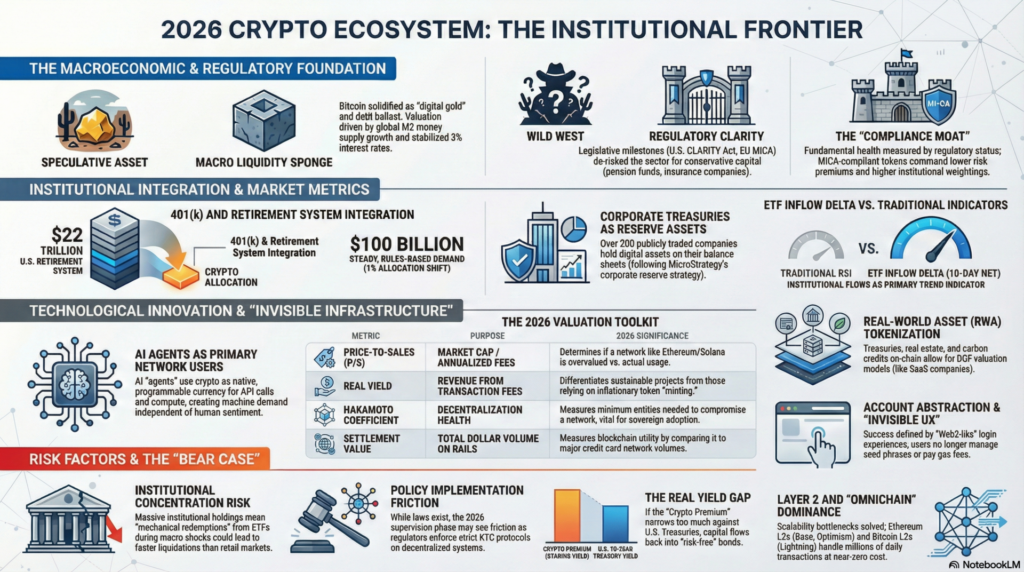
Monetary Policy & Interest Rates: Central banks, particularly the U.S. Federal Reserve, have settled into a “post-inflationary” stance. With rates stabilizing in the 3% range, the “risk-off” extreme of 2023-2024 has subsided. In this environment, Bitcoin has solidified its role as a “Macro Asset”—a liquidity sponge that absorbs excess capital when fiat currencies face debt-to-GDP pressures.
The Debt Ballast: With global public debt at record highs, institutional demand for “hard money” (assets with programmatic scarcity) has turned Bitcoin into a digital version of gold. Fundamental analysts now look at the M2 Money Supply growth as a primary indicator for crypto valuation.
2. The Institutional Era: The “ETF-ization” of Crypto
2026 marks the “Dawn of the Institutional Era.” The approval of spot ETFs for Bitcoin and Ethereum in previous years was the catalyst; today, the flows are the fundamental metric.
Retirement Integration: The biggest fundamental shift in 2026 is the inclusion of crypto in the $22 trillion U.S. 401(k) and Defined Contribution system. A mere 1% allocation shift represents over $100 billion in steady, rules-based demand—providing a “valuation floor” that didn’t exist in 2021.
Corporate Treasuries: Following the “Strategy Playbook” (MicroStrategy), over 200 publicly traded companies now hold digital assets on their balance sheets. Crypto is no longer just an investment; it is a corporate reserve asset.
3. Regulatory Clarity: The End of the “Wild West”
For the first time, “Regulation” is a tailwind rather than a threat.
The GENIUS & Clarity Acts: In the U.S., 2025 and 2026 legislation has provided a clear taxonomy for digital assets. Stablecoins are now regulated like high-tech “internet dollars,” and exchanges operate under bank-like supervision.
MiCA in Europe: The EU’s Markets in Crypto-Assets (MiCA) regulation has fully matured, providing a single market for digital assets across 27 countries. This has de-risked the sector for “conservative” capital (pension funds and insurance companies).
4. On-Chain Fundamentals: Network Activity over Hype
To value a network in 2026, we look at its “plumbing” performance:
Layer 2 Dominance: Scalability is no longer a bottleneck. Ethereum’s Layer 2 solutions (Optimism, Arbitrum, Base) and Bitcoin’s Lightning/L2 protocols handle millions of transactions daily at near-zero cost.
Stablecoin Velocity: Stablecoin market cap has exceeded $300 billion. The fundamental value of a blockchain is now measured by its Settlement Value—the total dollar amount moved across its rails—which currently rivals major credit card networks.
5. Real-World Asset (RWA) Tokenization
The “Killer App” of 2026 is tokenization. Everything from U.S. Treasuries to commercial real estate and carbon credits is moving on-chain.
Intrinsic Value Driver: By moving traditional assets onto blockchains, protocols generate “Yield” from real-world economic activity. This allows fundamental analysts to value tokens using Discounted Cash Flow (DCF) models, similar to how one would value a software-as-a-service (SaaS) company.
6. The Convergence of AI and Blockchain
In 2026, AI agents have become primary users of blockchain technology.
Autonomous Commerce: AI “agents” need a neutral, programmable currency to pay for API calls, compute, and data. Crypto is the native currency of the machine economy. This creates a non-human demand for tokens that is independent of market sentiment.
7. Sector Analysis: Where the Value Lies
Bitcoin (The Store of Value): Valued by scarcity and adoption as a reserve asset.
Ethereum & Solana (The Infrastructure): Valued by developer activity, transaction fees (burn rate), and the total value of assets secured on-chain (TVL).
DeFi 2.0 (The Financial Layer): Focused on “Real Yield” rather than inflationary “yield farming.”
8. Risk Factors: The New Fragilities
A professional analysis must include the “Bear Case”:
Policy Implementation Risk: While the laws exist, the supervision phase (2026) could see friction as regulators enforce strict KYC on decentralized protocols.
Concentration Risk: With massive institutional holdings, a “mechanical redemption” from an ETF during a macro shock could lead to sharper, faster liquidations than the retail-driven markets of the past.
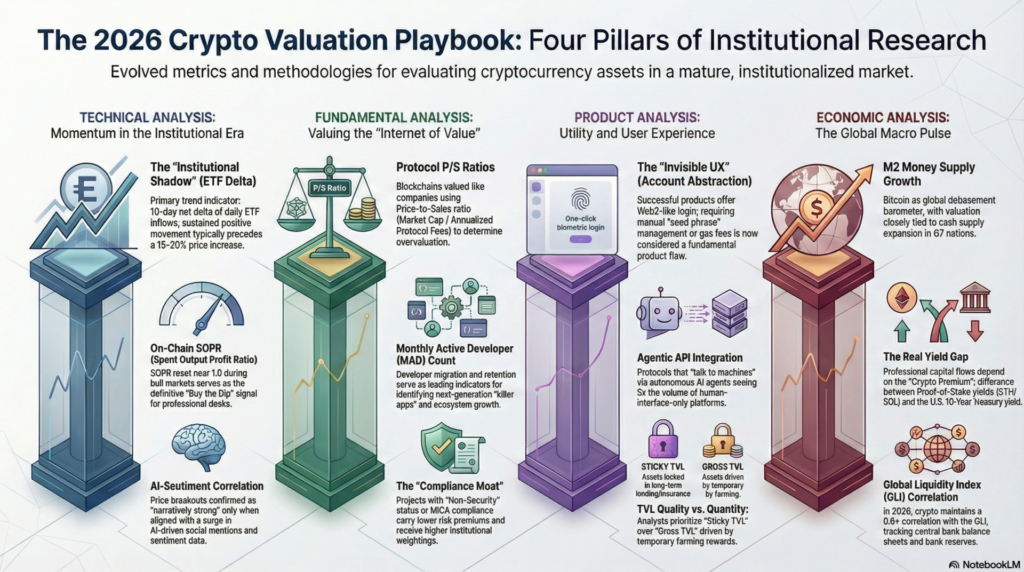
I. Technical Analysis (TA): Momentum in the Institutional Era
In 2026, TA has evolved beyond simple “chart patterns” to incorporate sophisticated liquidity and AI-driven metrics.
1. The “Institutional Shadow” (ETF Inflow/Outflow Delta): In 2026, the primary trend indicator is no longer just RSI, but the net delta of daily ETF inflows. A sustained positive delta over 10 days typically precedes a 15–20% price leg-up.
2. Cycle Termination Divergence: The traditional “4-year cycle” (linked to the Bitcoin Halving) is being challenged. Analysts now look for Realized Price vs. Market Price divergence to identify market tops, as institutional “HODLing” has reduced the impact of miners’ selling pressure.
3. Liquidity Heatmaps & Order Book Depth: With high-frequency trading (HFT) firms dominating, technical analysts use heatmaps to identify “liquidity pockets.” Large buy walls at psychological levels (e.g., $100k BTC) act as stronger magnets for price action than traditional Fibonacci retracements.
4. AI-Sentiment Correlation: Traders now use technical indicators that overlay “Social Sentiment” data from AI agents. When a price breakout aligns with a surge in AI-driven social mentions, it confirms the “narrative strength” of the move.
5. On-Chain SOPR (Spent Output Profit Ratio): This technical metric tracks whether market participants are selling at a profit or loss. In 2026, a SOPR reset near 1.0 during a bull market is the primary “Buy the Dip” signal for professional desks.
II. Fundamental Analysis (FA): Valuation of the “Internet of Value”
Fundamental analysis in 2026 focuses on the sustainability of revenue and the health of the underlying network.
1. Protocol Revenue & P/S Ratios: We now value blockchains like companies. For Ethereum or Solana, the Price-to-Sales (P/S) ratio (Market Cap divided by Annualized Protocol Fees) is the gold standard for determining if a network is overvalued compared to its actual usage.
2. Real Yield vs. Inflationary Yield: Analysts strictly differentiate between tokens that pay rewards via “minting” (inflation) and those that pay “Real Yield” from transaction fees. Projects with a net-deflationary supply (like post-EIP-1559 Ethereum) command a valuation premium.
3. Developer Retention Metrics: A core fundamental point is the Monthly Active Developer (MAD) count. Using data from repositories, analysts track if developers are migrating to a specific ecosystem, which is a leading indicator of future “killer apps.”
4. Regulatory Compliance Scoring: In 2026, a project’s fundamental health includes its “Compliance Moat.” Tokens that have achieved “Non-Security” status or are MiCA-compliant in Europe have lower risk premiums and higher institutional weightings.
5. Nakamoto Coefficient (Decentralization Health): This measures the minimum number of entities required to compromise a network. A rising Nakamoto Coefficient is a fundamental signal of increasing security and “censorship resistance,” vital for sovereign-level adoption.
III. Product Analysis: Utility and User Experience (UX)
Product analysis evaluates the “stickiness” and competitive advantage of specific decentralized applications (dApps).
1. The “Invisible UX” (Account Abstraction): The most successful products in 2026 utilize Account Abstraction. If a user has to manage a “seed phrase” or pay “gas fees” manually, the product is fundamentally flawed. Success is measured by “Web2-like” login experiences.
2. TVL Quality (Total Value Locked): Product analysis now looks deeper than “Gross TVL.” We analyze “Sticky TVL”—assets that aren’t just there for temporary farming rewards but are locked in long-term lending or insurance pools.
3. Cross-Chain Interoperability (The “Omnichain” Standard): Does the product work across multiple chains natively? In 2026, “siloed” dApps are losing market share to “Omnichain” protocols that allow users to swap or lend assets across Bitcoin, Ethereum, and Solana seamlessly.
4. AI-Agent Integration: A key research point is whether a product has an Agentic API. This allows autonomous AI agents to use the protocol. Protocols that “talk to machines” are seeing 5x the volume of those designed only for human interfaces.
5. Oracle Latency & Reliability: For DeFi products, the quality of their data feed (Oracles) is the most critical technical-product point. Analysts research the “latency” and “decentralization” of the price feeds to prevent flash-loan exploits.
IV. Economic Data Analysis: The Global Macro Pulse
Crypto does not exist in a vacuum; its fundamentals are tied to the “Price of Money.”
1. M2 Money Supply Growth: Bitcoin acts as a barometer for global debasement. When M2 (global cash supply) expands, crypto typically outperforms. Research focuses on the “rate of change” in M2 from the G7 nations.
2. The Real Yield Gap: Analysts compare the “Staking Yield” of proof-of-stake networks (like ETH/SOL) against the U.S. 10-Year Treasury yield. If the “Crypto Premium” is too narrow, capital flows back into “risk-free” bonds.
3. Global Liquidity Index (GLI): This data point tracks the total “liquidity” available in markets (central bank balance sheets + bank reserves). Crypto has a 0.8+ correlation with the GLI in 2026.
4. Inflation Breakevens: We monitor Inflation-Linked Bonds. If expectations for future inflation rise, Bitcoin’s “Digital Gold” narrative strengthens, leading to a fundamental re-rating.
5. USD Index (DXY) Correlation: The inverse relationship between the Dollar (DXY) and Crypto remains a pillar. A weakening DXY in 2026 is viewed as the primary “green light” for a crypto bull market.
V. Economic Announcements: Event-Driven Volatility
Strategic research into specific calendar events that trigger market shifts.
1. FOMC Minutes & Rate Guidance: The Federal Reserve’s “Dot Plot” remains the most significant announcement. In 2026, the market is particularly sensitive to any talk of “Quantitative Easing” (QE) or “Balance Sheet Expansion.”
2. SEC/CFTC Taxonomy Updates: Official announcements regarding the classification of “Altcoins” (Security vs. Commodity) can cause 30% swings in specific sectors. Bipartisan support for the CLARITY Act is the most watched legislative event this year.
3. Stablecoin Reserve Audits: Monthly attestation announcements from major issuers (Circle, Tether) are critical. Any “de-pegging” risk in these reports is viewed as a systemic threat to the entire ecosystem.
4. Employment Data (Non-Farm Payrolls): In 2026, “bad news is good news.” Soft employment data suggests the Fed will keep rates low, which is historically bullish for “scarce” assets like Bitcoin.
5. G20 Regulatory Frameworks: Announcements regarding the “Global Travel Rule” for crypto transactions. Success in cross-border regulatory harmony is a “buy” signal for infrastructure projects.
Conclusion: Maturity and the “Invisible” Blockchain
The fundamental conclusion for 2026 is that cryptocurrency has become “invisible infrastructure.” Much like the internet’s TCP/IP protocol, users are interacting with blockchains through their bank apps, AI assistants, and payment platforms without needing to understand “private keys.”
For the investor, this means the era of 10,000% gains in a week is largely over, replaced by a market that rewards patience, protocol revenue, and real-world utility.
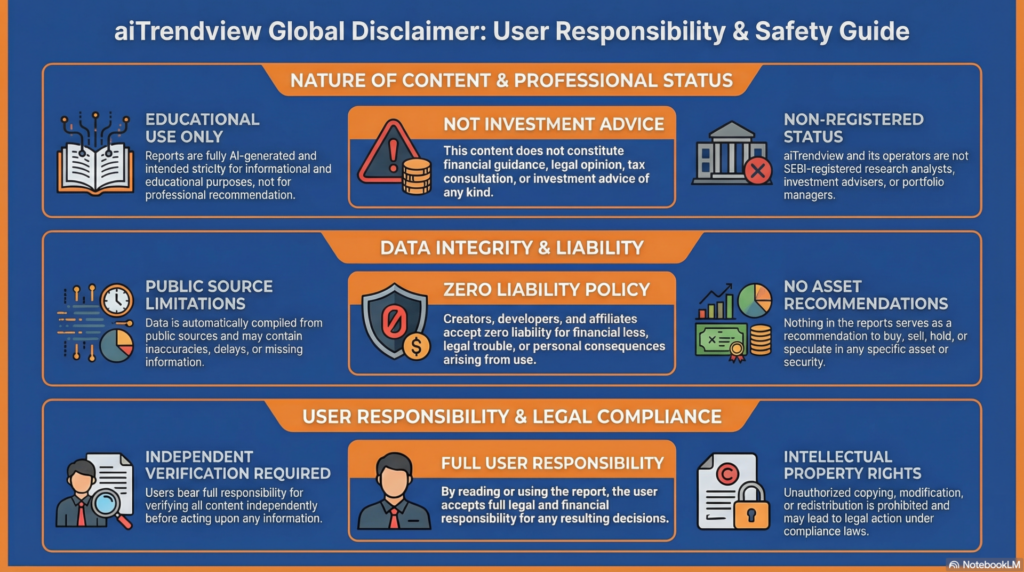
Legal Disclaimer & Liability Waiver
This AI-generated report is strictly educational and does not constitute financial, legal, or professional advice. aiTrendview and its affiliates are not SEBI-registered advisors and assume zero liability for any losses or consequences resulting from its use. All data is autonomously harvested from public sources and may be flawed, delayed, or incomplete; therefore, you assume exclusive responsibility for independently verifying information before taking any action. Under no circumstances should this content be construed as a recommendation to trade or speculate in any security. By accessing this material, you acknowledge that any reliance on this data is at your sole risk, and you agree to be bound by strict intellectual property protections prohibiting the unauthorized redistribution or modification of this work.
Notice: Function WP_Scripts::add was called incorrectly. The script with the handle "hcaptcha-elementor-pro" was enqueued with dependencies that are not registered: hcaptcha. Please see Debugging in WordPress for more information. (This message was added in version 6.9.1.) in /var/www/vhosts/aitrendview.com/httpdocs/wp-includes/functions.php on line 6131