
This fundamental research report provides a professional-grade analysis of Eli Lilly and Company (LLY) based on fiscal year 2025 data and recent Q3 2025 performance. For advanced readers, this report moves beyond the “obesity hype” to analyze the structural financial efficiency and capital allocation strategies of the world’s first trillion-dollar healthcare entity.
Fiscal year 2025 will be remembered as the year Eli Lilly successfully transitioned from a legacy pharmaceutical giant into a high-growth “biopharma-tech” powerhouse. Driven by a historic 54% YoY revenue surge in Q3 2025, the company has fundamentally rewritten the rules of pharmaceutical scaling. This growth is not merely a product of market demand but a result of aggressive “at-risk” manufacturing expansion and a diversified pipeline that now includes multi-billion dollar pillars in neurology and immunology.
As we conclude 2025, Lilly’s financial profile resembles a high-margin software firm more than a traditional drugmaker. With GAAP Net Income nearly quintupling and non-GAAP EPS consistently beating elevated consensus estimates, the company is utilizing its massive cash flow to fortify its lead against Novo Nordisk. This report dissects the ten financial and operational parameters that define Lilly’s current market dominance and its 2026 trajectory.
For FY 2025, Eli Lilly raised its full-year revenue guidance to a range of $63.0 billion to $63.5 billion, representing a staggering growth profile for a large-cap healthcare firm. The primary catalyst is the “incretin” portfolio (Mounjaro and Zepbound), which accounted for nearly $10 billion in a single quarter (Q3). This revenue growth is increasingly global, with international sales surging 74% as supply constraints eased across Europe and Asia.
The sales numbers for Lilly’s flagship tirzepatide molecules are unprecedented. Mounjaro (Diabetes) generated $6.52 billion in Q3 alone (up 109% YoY), while Zepbound (Obesity) skyrocketed to $3.59 billion. These two products now represent the highest-velocity drug launches in pharmaceutical history, effectively creating a “duopoly” market with Novo Nordisk’s Wegovy.
Advanced readers should note Lilly’s exceptional non-GAAP Gross Margin of 83.6%. This 140-basis-point expansion YoY is a direct result of “favorable product mix”—meaning higher-margin obesity drugs are making up a larger portion of total sales—and increased internal manufacturing efficiencies as new sites in North Carolina and Germany came online.
Lilly’s profitability has reached an inflection point. In Q3 2025, the company reported GAAP Net Income of $5.58 billion, a massive leap from $970 million in the prior-year period. Full-year non-GAAP EPS guidance was raised to $23.00–$23.70, reflecting the company’s ability to convert rapid top-line growth into bottom-line alpha.
Lilly spent a record $12.56 billion on R&D over the trailing twelve months ending Sept 2025 (up ~19%). Crucially, this capital is being diversified. While metabolic health remains the core, significant investment is being funneled into Kisunla (Alzheimer’s) and the oncology pipeline (Verzenio), ensuring the company has a “second act” once the obesity market matures.
To solve the supply shortages of 2024, Lilly committed over $20 billion in total planned CapEx toward manufacturing. In 2025, this included a $1.2 billion modernization of the Puerto Rico site and new facilities in Texas. This “bricks and mortar” strategy creates a high barrier to entry for competitors who lack the infrastructure to produce complex biologics at this scale.
Despite the heavy CapEx, Lilly maintains a robust balance sheet. Operating cash flow has scaled in tandem with revenue, allowing the company to fund acquisitions (like Verve Therapeutics) and organic growth without significant dilution. The company also raised its quarterly dividend to $1.73 per share, signaling management’s confidence in long-term cash stability.
A critical fundamental to watch is the 10-15% decline in realized prices. As Lilly secures broader insurance coverage (Formulary access), it is trading higher rebates for massive volume increases. This “volume-over-price” strategy has been successful, as evidenced by a 62% jump in volume that easily offset the pricing headwinds.
Lilly has pulled ahead of Novo Nordisk in 2025 in terms of market valuation and pipeline breadth. While Novo faced guidance cuts and manufacturing resets, Lilly’s “execution premium” is reflected in its $1 trillion+ market cap. Head-to-head data showing tirzepatide’s superior efficacy over semaglutide remains a primary fundamental tailwind.
Lilly trades at a significant premium to the S&P 500 (Forward P/E ~50x). This valuation is predicated on the “Triple G” thesis: Growth in Obesity, Growth in Alzheimer’s, and Growth in oral GLP-1s (Orforglipron). With Phase 3 data for oral obesity meds expected soon, the transition from injectable to oral remains the next multi-billion dollar catalyst.
| Parameter | Eli Lilly (LLY) | Novo Nordisk (NVO) | Johnson & Johnson |
| Total Revenue (FY25E) | $63.2 Billion | ~$48 Billion (Est.) | $90.5 Billion |
| Revenue Growth (YoY) | ~54% | ~25% | ~5% |
| Gross Margin | 83.6% | 83.9% | 68.4% |
| Net Profit Margin | 31.7% | 33.5% | 23.1% |
| Market Cap | $1.05 Trillion | ~$250 Billion | $385 Billion |
Eli Lilly is no longer a “value” pharmaceutical play; it is a momentum-driven growth asset. The 2025 financials confirm that the company has reached escape velocity, with its Energy-like margins and tech-like growth rates. The primary risk remains political/regulatory pricing pressure, but with its fortified balance sheet and manufacturing moat, Lilly is uniquely positioned to dominate the next decade of healthcare.
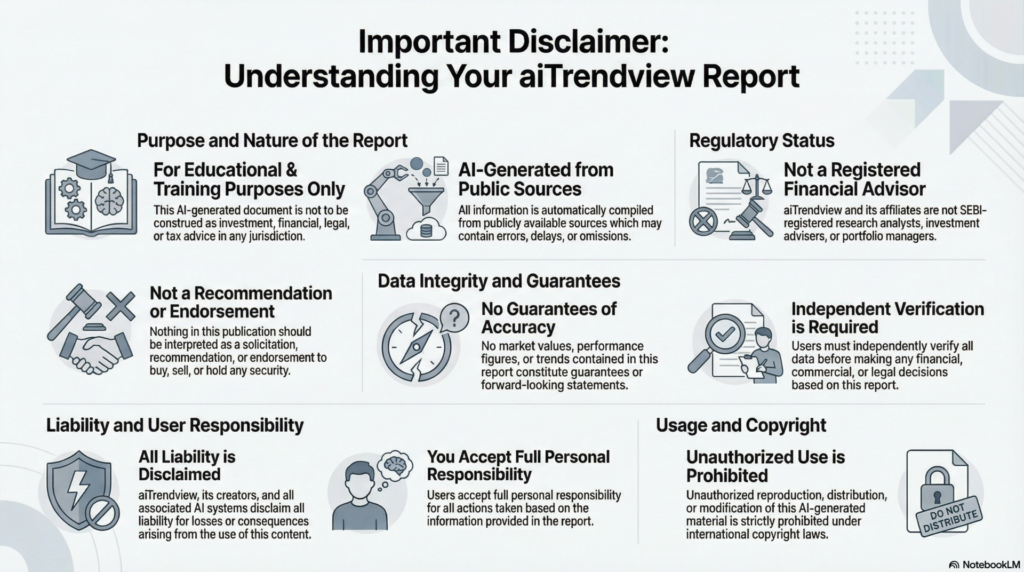
aiTrendview Global Disclaimer
This aiTrendview report is an AI-generated document provided exclusively for educational and training purposes and shall not be construed as investment, financial, legal, or tax advice in any jurisdiction.
aiTrendview and its affiliates are not SEBI-registered research analysts, investment advisers, or portfolio managers, and all information herein is automatically compiled from publicly available sources that may contain errors, delays, or omissions.
Users must independently verify all data before making any financial, commercial, or legal decisions, as no market values, performance figures, or trends contained in this report constitute guarantees or forward-looking statements.
Nothing in this publication should be interpreted as a solicitation, recommendation, or endorsement to buy, sell, or hold any security.
aiTrendview, its creators, and all associated AI systems disclaim all liability for losses or consequences arising from the use or reliance upon this content, and users accept full personal responsibility for all actions taken based on it.
Unauthorized reproduction, distribution, or modification of this AI-generated material is strictly prohibited under international copyright, compliance, and intellectual-property laws.