
The AI Infrastructure Monopoly: NVIDIA’s Multi-Trillion Dollar Transformation
The fiscal year 2025 has cemented NVIDIA Corporation (NVDA) not merely as a semiconductor manufacturer, but as the foundational architect of the generative AI era. While the broader tech sector grappled with high interest rates and cautious enterprise spending, NVIDIA delivered a financial performance that defied historical hardware cycles. Total revenue for FY 2025 skyrocketed to $130.5 billion, a staggering 114% year-over-year (YoY) increase, driven almost entirely by the insatiable demand for the Hopper and Blackwell architectures.
For the institutional-grade investor, NVIDIA’s narrative has evolved from “gaming GPUs” to “AI factories.” The company’s Data Center segment now accounts for nearly 88% of total revenue, reflecting a total modernization of the global computing stack. With a market capitalization recently peaking over $4 trillion, NVIDIA’s fundamental strength lies in its “full-stack” ecosystem—integrating proprietary silicon, the CUDA software layer, and high-speed networking—creating a competitive moat that rivals like AMD and Intel are finding increasingly difficult to bridge.
1. Top-Line Revenue: The Hyper-Growth Anomaly
NVIDIA’s FY 2025 revenue reached an unprecedented $130.5 billion, up from $60.9 billion in FY 2024. This growth is historically unique for a company of its scale. Quarterly revenue reached $57 billion by Q3 of the following fiscal cycle, signaling that the “AI build-out” phase is still accelerating rather than peaking.
2. Data Center Dominance: The New Global Utility
The Data Center segment generated $115.2 billion in FY 2025, a 142% increase YoY. This segment has become the company’s primary engine, fueled by Hyperscalers (AWS, Google, Microsoft) and “Sovereign AI” initiatives where nations build their own domestic AI compute power.
3. Unrivaled Profitability: Industry-Leading Margins
NVIDIA maintained a GAAP Gross Margin of 75.0% for the full year. Unlike traditional hardware companies that see margins erode as they scale, NVIDIA’s software-integrated model allows it to command premium pricing. Operating margins settled at a remarkable 62.4%, demonstrating immense operating leverage.
4. Earnings Per Share (EPS) and Net Income
GAAP Net Income for FY 2025 hit $72.9 billion, up 145% from $29.8 billion in FY 2024. This translated to a Diluted EPS of $2.94 (post-split). The company’s bottom-line growth has consistently outpaced revenue growth, highlighting superior cost management and high-margin product mix.
5. Free Cash Flow (FCF) and Shareholder Returns
NVIDIA is a cash-generation machine, producing operating cash flow in excess of $14.5 billion per quarter. In FY 2025, the company returned over $15.4 billion to shareholders via buybacks and dividends and authorized an additional $50 billion share repurchase program, signaling management’s confidence in long-term valuation.
6. R&D Velocity: The Blackwell/Rubin Roadmap
NVIDIA’s R&D expenditure rose to $16.7 billion (TTM as of late 2025), a 43% increase. This spend is focused on shortening the product lifecycle; the company has moved to a one-year release cadence, transitioning from Hopper to Blackwell, with the “Vera Rubin” architecture already slated for 2026.
7. Networking Segment: The Silent Moat
Through its Mellanox acquisition, NVIDIA’s networking revenue (InfiniBand and Spectrum-X Ethernet) has become a multibillion-dollar business. As AI clusters grow to hundreds of thousands of GPUs, the “interconnect” becomes as critical as the chip itself, a sector where NVIDIA holds a significant technical lead.
8. The Gaming Pivot: From Core to Catalyst
While Gaming revenue grew 9% to $11.4 billion, its share of total revenue fell to under 9%. However, Gaming now serves as a testing ground for “AI PCs” and edge-AI technologies, ensuring NVIDIA remains the dominant player in the consumer-facing hardware market.
9. Automotive and Robotics: The Next Frontier
Automotive revenue reached $1.7 billion in FY 2025 (+55% YoY). With partners like Toyota and BYD adopting the NVIDIA DRIVE platform and the launch of the Cosmos robotics platform, NVIDIA is positioning itself to be the “brain” of the world’s autonomous machines.
10. Inventory and Supply Chain Dynamics
Despite the high demand, NVIDIA managed to stabilize its supply chain in 2025. While Blackwell remains “sold out” for several quarters, the company’s transition to TSMC’s advanced packaging (CoWoS) has allowed for more predictable shipment ramps, reducing the “inventory shocks” seen in previous years.
NVIDIA vs. The Competition: Sector Benchmark (FY 2025)
| Parameter | NVIDIA (NVDA) | AMD | Intel (INTC) |
| Annual Revenue | $130.5 Billion | $27.8 Billion | $53.0 Billion |
| Gross Margin | 75.0% | ~50.0% | 35.0% |
| Market Cap (Avg) | $3.5 – $4.0 Trillion | $205 Billion | $94 Billion |
| Data Center % | 88.3% | ~40.0% | ~25.0% |
| R&D Spend (TTM) | $16.7 Billion | $5.9 Billion | $16.0 Billion |
NVIDIA FY 2025 Performance Summary
| Metric | 2025 Performance | Trend | Strategic Status |
| Total Revenue | $130.5 Billion | 🟢 +114% | All-time record high. |
| Net Income | $72.9 Billion | 🟢 +145% | Massive profit expansion. |
| Gross Margin | 75.0% | 🟢 +230 bps | Sector-leading pricing power. |
| Cash Reserves | $34.8 Billion | 🟢 Strong | Fuels aggressive R&D/M&A. |
| Data Center Rev | $115.2 Billion | 🟢 +142% | Complete market dominance. |
| EPS (Diluted) | $2.94 | 🟢 +147% | Outpacing revenue growth. |
The Investor’s Verdict
NVIDIA is currently operating in a “virtuous cycle” where its massive profits fund the very R&D that makes its competitors’ offerings obsolete before they reach the market. The primary risk for NVIDIA is no longer “competition” in the traditional sense, but rather a potential “digestion period” among hyperscalers or geopolitical shifts affecting TSMC’s manufacturing.
aiTrendview Global Disclaimer
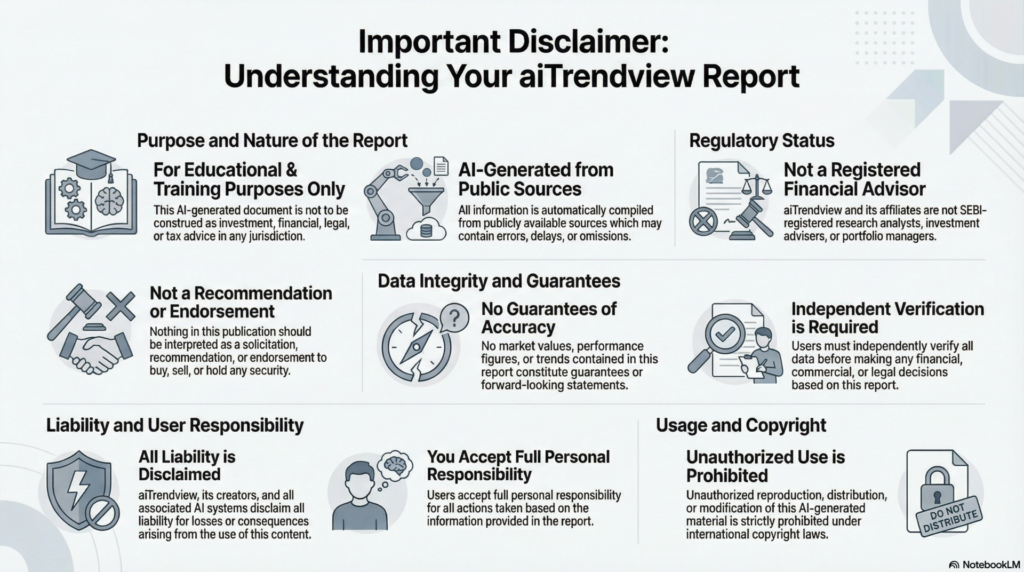
This aiTrendview report is an AI-generated document provided exclusively for educational and training purposes and shall not be construed as investment, financial, legal, or tax advice in any jurisdiction.
aiTrendview and its affiliates are not SEBI-registered research analysts, investment advisers, or portfolio managers, and all information herein is automatically compiled from publicly available sources that may contain errors, delays, or omissions.
Users must independently verify all data before making any financial, commercial, or legal decisions, as no market values, performance figures, or trends contained in this report constitute guarantees or forward-looking statements.
Nothing in this publication should be interpreted as a solicitation, recommendation, or endorsement to buy, sell, or hold any security.
aiTrendview, its creators, and all associated AI systems disclaim all liability for losses or consequences arising from the use or reliance upon this content, and users accept full personal responsibility for all actions taken based on it.
Unauthorized reproduction, distribution, or modification of this AI-generated material is strictly prohibited under international copyright, compliance, and intellectual-property laws.